Public Relations Campaign:
“Threads That Connect Us”
Client: Stitch Buffalo
by Stephanie Codd, Courtney Helinski and Noor Mian
COM 650
Dr. Silverman
December 2, 2025
Executive Summary
“Threads That Connect Us” is a comprehensive public relations campaign designed to strengthen and expand the mission of Stitch Buffalo, a textile arts nonprofit empowering refugee and immigrant women through creativity, community, and sustainable design. Rooted in extensive research, stakeholder interviews, and an in-depth analysis of Stitch Buffalo’s identity and goals, this campaign provides a strategic roadmap to increase brand awareness, broaden geographic reach, engage younger audiences, reinforce community partnerships, and enhance organizational resilience through proactive crisis communication planning.
Overview and Key Findings:
Formative research revealed Stitch Buffalo as a deeply valued community arts organization grounded in empowerment, cultural expression, and sustainability. With programs such as the Refugee Women’s Workshop, community textile classes, and Second Stitch reuse initiatives, the organization authentically embodies its mission. Stakeholder interviews with Development & Communications Director Michelle Perkins highlighted both exciting developments and emerging challenges: rapid growth, newly acquired space, upcoming staff transitions from contract to full- time roles, and the desire to expand beyond Western New York while maintaining the safety and dignity of the women they serve. The research also identified key opportunities, including a strong social media presence, engaged volunteer base, and a growing national interest in ethical and sustainable handmade goods. Weaknesses, such as limited staff bandwidth and the need for updated digital infrastructure, which further informed the strategies and tactics outlined in this campaign.
Campaign Goal and Strategic Focus:
The overarching goal of the “Threads That Connect Us” campaign is to broaden Stitch Buffalo’s impact beyond its local footprint by sharing the artistry, stories, and cultural heritage of its refugee and immigrant artisans with wider audiences. This will be achieved through three interconnected strategic areas:
1. Crisis Communication Preparedness
To safeguard trust and ensure timely, compassionate communication during organizational or political challenges, the campaign introduces a full crisis communication plan. The plan establishes designated spokesperson roles, pre-drafted statements, and step-by-step protocols responding to potential risks such as misinformation, political discourse around immigration, or crises stemming from staff transitions.
2. Digital Storytelling & Social Media Expansion
Leveraging Stitch Buffalo’s strong social media foundation, the campaign amplifies brand visibility through emotionally driven storytelling, TikTok and Instagram Reels, influencer outreach, and geotargeted advertising. A signature storytelling series—“Threads That Connect Us”—spotlights artisans transitioning to full-time staff, celebrates wholesale partners, and reinforces the human connections at the heart of Stitch Buffalo’s brand.
3. E-Commerce & Wholesale Growth
To support geographic expansion and increased revenue, the campaign recommends investing in online inventory, website modernization, and wholesale outreach. A professional product catalog, targeted outreach to museum gift shops and ethical retailers, and strengthened partnerships with cultural institutions support meaningful long-term growth.
Target Publics
The campaign prioritizes two key audiences: Current core supporters: Buffalonians, donors, and socially conscious consumers ages 40–70.
Potential publics: Younger adults (ages 20–30), college students, ethical shoppers, and consumers across New York State and the East Coast.
Key Messages All messaging emphasizes empowerment, cultural connection, sustainability, and community. Core themes—Empowerment Through Art, Connection and Compassion, Sustainable and Ethical Design, and Community and Growth—are woven throughout all communications to deepen emotional resonance and unify campaign storytelling.
Tactical Overview Across social media, community relations, advertising, and wholesale outreach, the campaign includes:
• A featured artisan spotlight series announcing staff transitions
• Social media takeovers by artisans
• Influencer partnerships outside WNY
• Geolocation-based advertising
• Magazine and billboard placements
• Strengthened wholesale relationships supported by a new catalog
• College and university outreach
• Community workshops and collaborative events
• Website and email newsletter integration
• A full crisis communication plan with team roles and templates
Together, these tactics expand visibility, strengthen donor and partner relationships, and position Stitch Buffalo as a nationally recognized leader in ethical handmade goods.
Evaluation Approach
The campaign will be evaluated based on awareness, acceptance, and action outcomes using social media analytics, website metrics, sales data, donor engagement, wholesale partnerships, event participation, and internal feedback. This comprehensive evaluation ensures that Stitch Buffalo can measure progress meaningfully and apply insights to future growth.
Conclusion
“Threads That Connect Us” is more than a communications campaign—it is a celebration of
resilience, creativity, and community. By elevating artisan stories, strengthening organizational
infrastructure, and expanding digital reach, this campaign positions Stitch Buffalo for sustainable
growth and long-term impact. Through thoughtful strategy and authentic storytelling, the
campaign honors the women at the heart of the organization while building new pathways for
national visibility and support.
Phase One: Research
I. Formative Research
We began with a content analysis of Stitch Buffalo’s website, stitchbuffalo.org, to determine
who the client is and what they stand for. Stitch Buffalo is a nonprofit 501c3 organization that
was founded in 2014 with the simple desire to gather and create, supporting local refugee women
that have relocated to Buffalo by teaching them a skill (hand sewing), and selling their creations
while allowing them to share in the profits. Their mission statement currently reads: Stitch
Buffalo is a textile art center committed to empowering refugee and immigrant women through
the sale of their handcrafted goods, inspiring creativity and inclusion through community
education, and stewarding the environment through the re-use of textile supplies. Their values
Include:
Community Building: Bringing people together through the textile arts.
Empowerment: Maintaining a welcoming environment that fosters fair and equitable opportunity and self-expression.
Trust: Forging an inclusive and trustworthy space where each individual’s cultural traditions and lived experiences can be expressed and preserved.
Passion: Working, learning and celebrating together in pursuit of innovation and personal expression.
Environmental Stewardship: Reducing waste by keeping useful materials out of landfills and in the hands of creative people.
Stitch Buffalo’s current programs include:
1. Refugee Women’s Workshop
The Refugee Women’s Workshop is a thriving community of women artists from Bhutan, Burma, Nepal, Thailand, Egypt, Afghanistan, and beyond who sew handcrafted goods for sale in 6 the community. Through the creation of handcrafted textiles, each artist nurtures her artistic heritage while affirming her self-worth as a woman and a human being.
2. Community Classes
Stitch Buffalo offers textile arts classes each month taught by staff, experts in the community, and members of the Refugee Women’s Workshop. From embroidery and dyeing to sewing and weaving, classes inspire creativity and foster cross-cultural interactions in a diverse and welcoming space.
3. Second Stitch
Through the Second Stitch sustainability program, they give a second life to donated textile art supplies. These materials are integral to the products in the Refugee Women’s Workshop and the projects in community classes. Items we can’t use directly are offered to the community at substantial discounts—to keep useful materials out of landfills and in the hands of local artists. All proceeds directly support Stitch Buffalo programming.
Stitch Buffalo considers themselves to be inclusive, diverse, supportive and sustainable. A grassroots organization committed to building community through creativity.
II. Situation Analysis
Upon a deeper dive, the team expanded their research to include an hour long Zoom call with
Michelle Perkins, Development and Communications Director, followed by an in person
interview with Michelle and an in person tour of the Stitch Buffalo space located at 284
Plymouth Avenue, Buffalo NY.
During the Zoom call, we discovered that Stitch Buffalo desires to expand their reach outside of
the WNY geographical area, reach a potentially younger audience, and feel more ready for crisis
situations and unexpected transitions that may come their way. It was determined that the team
would build a crisis communications plan into the PR campaign. Michelle explained that Stitch
Buffalo is in the midst of a staff transition in which contract workers will ultimately become full
time employees, something that has not been done before. This can lead to the potential for
disgruntled staff to voice opinions publicly, which is a concern for their image. It also has the
potential to generate a lot of positive PR, as the organization is taking a large step in a direction
they believe in – ultimately supporting refugee women to the highest ability possible. Michelle
expressed that Stitch Buffalo is concerned about the politically charged environment we
currently face in this country affecting their work with immigrants, however, noted that they
have not received any pushback or backlash thus far. Michelle noted that they do have an
operations crisis plan in terms of what they may do if raided by ICE, for example, but that it did
not include any crisis communication strategies. They wanted to express the importance of
upholding confidentiality in personal matters such as someone’s immigration status or current
place of residence, as the safety of their contractors is of utmost importance to them. The team is
excited to add the crisis communication plan into the campaign for them, so that they may feel
more prepared should a crisis situation unfold.
Michelle feels their priority is brand awareness, she desires the geographical expansion fueled
ultimately by potential new sales. She believes if more people from outside Buffalo hear about
their mission, they may want to purchase the handmade items from the refugee women and
ultimately, increased sales revenue means money that would allow them to fuel the future of
their mission. She describes the brand as homey, welcoming, humble, approachable, accessible.
Intrinsically human; she states the importance of the emotional connection being at the forefront
of their brand identity.
Currently, Stitch Buffalo has great relationships with media in the area, but they would like to
formalize their list of media contacts. They use social media frequently and have a good
following on Instagram and Facebook. Michelle expressed a desire to move into video content
on social media such as TikTok and reels, a solid strategy if wanting to engage with a younger
audience. They currently have an email newsletter with a high open rate, and engage often with
their constituents. They also engage in public outreach such as school and club visits, community
groups, grant programs and more.
II. Organization Analysis
The team scheduled an in-person walkthrough and tour of the Stitch Buffalo space at 284 Plymouth Ave, Buffalo NY on October 4th, 2025. It began with a casual look around the store (or “scouting”) to get a feel for the vibe as a potential consumer, and view the products being sold. The team was thoroughly impressed with the quality and presentation of the products and storefront. We agreed that Michelle’s description of homey, emotional connection and humble roots came through and could be felt just by entering the store. After an independent look around, Michelle gave the team a guided tour through the space that included the retail storefront, space for classes, creating, meeting, sorting donations, and office space.
Recently, the upstairs of the building they are renting became available, and it was written into their lease that they get first pass of the space. This came unexpectedly, and they did not have a plan for expansion or use of the space at the time, but they decided to jump on the opportunity and take the space upstairs for fear that space that close may not be available in the future when ultimately, they do want to expand, and they would have to go beyond their storefront and have a satellite location which would not be ideal. They are currently brainstorming exactly how to utilize that space.
Michelle admits to currently growing faster than is sustainable, which is a good problem to have, but is currently a challenge the organization is facing. At the present moment, they only have four full time staff members. They happen to have an all-female staff and an all-female board, something not entirely planned by design but that they are proud of – they are for women, by women.
As all of their clients are refugee women (they do not currently accept men at all) it makes them more comfortable to be in a female environment, as many of these women come from cultures where it would be inappropriate to spend so much time away from the home and in the company of men besides their husband or family members. Stitch Buffalo is also currently toying with the idea of designing a new website, again crediting this to their insurmountable growth. They sell inventory online, but need to keep this as a 9 separate inventory than what is in store because everything is one of a kind, they do not want to sell something that is out of stock. Michelle feels their current website is “text dense” and wants to improve the style to keep up with the ever-changing landscape of the internet. They currently sell more inventory in store than online.
III. Target Publics:
Current: Buffalonians, people who care deeply about refugees and live locally to Buffalo, women age 40-70, family-oriented people with homey values
Potential: outside of WNY – all across New York State, the East Coast, the United States; Gen Z (younger demographic) age 20-30 young adults with disposable income, college students.
IV. SWOT Analysis:
Strengths: Good relationships with the media, strong social media presence, over 75 volunteers, a strong passion for the mission, dedicated staff.
Opportunities: New space expansion recently acquired, staff transition upcoming of transitioning contract workers to staff members, expanding geographically beyond WNY, Gen Z support, more online sales by increasing online inventory.
Weaknesses: Small staff (only 4 full time) which is spread thin, growing faster than may be sustainable.
Threats: Current political climate and opinion on immigration, ICE raids, potential for contract workers to become disgruntled former employees as they transition to employees in the future (concern was brought up about this from Michelle)
V. Supplemental Materials:
Michelle provided several documents from Stitch Buffalo for the team to review including:
-Strategic Plan
-Donor Stewardship Plan
-Brand Positioning
10
-General Presentation on History
-Program Talking Points
-Board Members Philanthropy and Development Commitment
-Social Media Strategy
-Culture of Philanthropy Statement
A few things to note after reviewing the supplemental documentation provided by
Michelle…
The current social media strategy is very strong:
GRID POSTS
• Weekly Goal: 2x Products, 2x Story/mission, 1x Classes/events, 1x Services, 1x Second Stitch
• Mix of reels, carousels, and photos
• Cross posted to Instagram and Facebook
• Wednesday and Thursday posts shared to LinkedIn
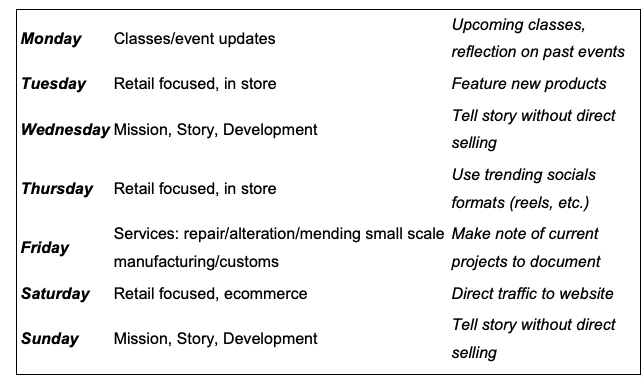
STORIES:
Less structured, but typically reinforce grid post themes or reflect up-to-the-moment goings on
around the store and studio.
The team believes this strategy is strong and has a proven success record already; Stitch Buffalo
currently has 9,462 followers on Instagram and 8.5K followers on Facebook which is stellar for a
small and local nonprofit. We would advise you keep this strategy as it is specific, distinct and
measurable and easy to hold yourself accountable to. Just add to it as advised in the tactics
section in order to increase your audience to new age and geographic demographics.
The donor stewardship plan is also very strong. Stitch Buffalo is committed to thanking every
donor and offering personalized acknowledgements; something that ties into their intrinsically
human, emotional connection projected by their brand. We love the donor wall: “We feature
supporters in our “Blooming Wall of Community Support.” At the $5000+ level, they are
acknowledged with a medium hand-embroidered flower including their name and logo. At the
$10,000+ level, they are acknowledged with a medium hand-embroidered flower including their
name and logo.” This is another fantastic human touch point with donors, keep it up! Maybe you
can post more information about this donor wall on your social media, both to thank the donors
that are up there and encourage more people to donate so they can be added to it.
It is an excellent idea to have board members sign a commitment explaining how much they can
financially commit to, and emotionally as well enforcing them to join a committee. Many
nonprofits struggle with board engagement, Stitch Buffalo is being proactive to keep their board
engaged and it is paying off for them as Michelle states they have a wonderful, fully engaged
board at the moment and it is helpful for the development of the organization. Having a
connected board that cares about your mission enough to work hard will take your brand further!
VI. Competitor Case Study: Indego Africa
Indego Africa is a larger nonprofit with a similar mission, product and clientele. Since 2007,
Indego Africa has been propelling the creation, growth, and sustainability of women-owned
12
businesses in Africa. They equip artisan partners with the vocational skills, business know-how
and pipeline to global markets so they can become self-sufficient entrepreneurs.
Their mission statement is “Exceptional products made by women who are changing the future
for themselves, their families and their communities.”
Their values are: Local + Sustainable, Celebrating Craftsmanship, Transparent Partnerships and
Long-Term Impact.
View their website here: https://indegoafrica.org/
Indego Africa currently has 27.1K followers on Instagram. They have posts on having solidarity
with refugees, thanking their donors for donations and explaining how they get reused for
ultimate sustainability, using natural fibers, and also many fashionable features really
highlighting the quality of the products. All of this, Stitch Buffalo also has and can feature. Their
e-commerce site is very strong with a lot of online inventory. In order to grow geographically,
many people who do not live in Buffalo will want to purchase your products online, so you will
need to grow your online inventory and really invest in your website. Indigo Africa also has a
page right on their website that explains partnering with them, wholesaling with them, and lists
their current partners with some top names including Tory Burch.
Indego Africa has a large staff that can sustainably support their growth. This includes 15 full
time staff featured on their website, separating positions like having both a director of marketing
& communications and a director of fundraising and development, as well as production
managers, design managers, wholesale account managers, etc. As Stitch Buffalo transitions their
contract workers to full time staff, they may want to consider adding different roles to those staff
person’s positions such as having someone dedicated to wholesale relationships, having someone
else dedicated to marketing, if this is an area that interests them on top of their sewing and design
responsibilities.
Indigo Africa also has many statements about their impact on their website, with statistics like
90% (of clients) Report their income has increased since partnering with Indego Africa
97% (of clients) Say the skills gained from Indego Africa programs will help them to earn
income in the future
2x Increase in artisans who have been able to start a new side business outside of their
artisan cooperative since 2021
100% Say their confidence has increased
This is impactful and can be found as a footer on almost every page to remind you what your
purchase is really supporting.
Michelle mentioned wanting to do a website redesign in the near future, you may want to look at
the Indego Africa website for some ideas as their sales and following does very well on a
national scope which is what you are trying to achieve.
Phase Two: Strategy
Goal: To expand Stitch Buffalo’s impact beyond Western New York by sharing the artistry and
stories of refugee and immigrant women with wider audiences, strengthening donor and
customer relationships, engaging younger generations in ethical and inclusive creativity, and
ensuring the organization’s continued resilience through proactive, compassionate
communication and crisis preparedness.
Objectives:
Awareness Objective: Increase awareness of Stitch Buffalo’s mission and artisan work by 25%
over the next year through targeted media coverage, storytelling campaigns, and social media
engagement.
Action Objective: Grow e-commerce sales by 20% and donor engagement by 15% within 12
months through digital marketing and outreach efforts.
Response Objective: Build and implement a crisis communication plan to ensure timely,
empathetic, and transparent responses to any issues that could affect reputation or trust.
Strategy Overview:
Our strategy focuses on three interconnected areas: crisis communication planning, social
media marketing, and e-commerce expansion. These components were chosen to align with
Stitch Buffalo’s goals of sustainability, visibility, and empowerment.
Crisis Communication: Developing a proactive and compassionate plan will help protect Stitch
Buffalo’s reputation and ensure consistent, values-based messaging during potential challenges.
Social Media Marketing: Expanding Stitch Buffalo’s digital storytelling will highlight the
artisans’ work, attract younger audiences, and foster emotional connections with new and
existing supporters.
E-Commerce Growth: Strengthening the online shopping experience and showcasing products
through social platforms will help extend Stitch Buffalo’s reach beyond Western New York and
create new revenue opportunities.
By combining these strategies, Stitch Buffalo can deepen community trust, broaden its national
visibility, and ensure long-term resilience as a creative and socially conscious organization.
Key Message Development:
The key messages for the Stitch Buffalo PR campaign are designed to communicate the
organization’s mission, values, and impact clearly and consistently across all channels. Each
message connects to the campaign’s three strategic focuses: crisis communication, social media
storytelling, and e-commerce growth.
1. Empowerment Through Art: Stitch Buffalo transforms creativity into opportunity by
empowering refugee and immigrant women to share their artistry, gain financial independence,
and build community through textile arts.
2. Connection and Compassion: Every handmade piece carries a story of resilience, belonging,
and cultural exchange. Supporting Stitch Buffalo means supporting women who bring diverse
traditions and perspectives to life through their craft.
3. Sustainable and Ethical Design: Stitch Buffalo promotes mindful, ethical consumption by
offering handmade, sustainable products that connect consumers to the makers behind each
Creation.
4. Community and Growth: Stitch Buffalo’s impact reaches beyond Western New York, inspiring
individuals everywhere to value inclusion, creativity, and the power of women’s stories.
These messages will be adapted to fit different audiences and platforms — from heartfelt artisan
features on social media to concise, mission-driven language in crisis communication and donor
outreach. By consistently reinforcing these themes, the campaign will strengthen brand
recognition, emotional engagement, and long-term support for Stitch Buffalo’s mission.
Phase Three: Tactics
Part 1: Social Media and Advertising
1. Objective:
– The main objective of this portion of the plan is to build brand awareness outside of the WNY
geographic area and appeal to a younger audience
2. Strategies:
– This objective will be achieved by spreading the social media and paid advertising reach to
people who live outside of the WNY area using geotagging, and expanding into TikTok and
creating more social media content that is specifically tailored to Generation Z, and maintaining
existing connections and relationships.
3. TACTICS:
-”Threads that Connect Us” is a campaign idea in which Stitch Buffalo will announce publicly
that they are transitioning contract workers to full time staff members. You will announce this
publicly because it is a positive growth moment for the organization that will generate positive
buzz and thus increase brand awareness and sales
-Social Media Campaign “Threads that Connect Us” featuring intrinsically human imagery;
choosing one spokesperson out of the contractors that are becoming employees to be the face of
the campaign, make video content explaining their story and how far they have come and how
excited they are for the new changes at Stitch Buffalo. Post a natural looking headshot of each
contract worker that is becoming a staff person highlighting their backstory, biography and a
quote about how they’re excited about the new venture and the future of the organization.
-Use the title “Threads that Connect Us” to highlight the nature of the handsewn work, and the
connections we can form between human beings, as well as the connections built between the
contract workers and the organization that has led to the decision to bring them on as staff
members. Also use the title term to highlight community partnership connections in the area.
-Do social media features on your wholesalers; such as the Buffalo History Museum (Stitch
Buffalo wholesales to museum gift shops) under the same title “Threads that Connect Us” but
this time highlight the connection between your two organizations – both nonprofits, able to
support each other is a beautiful thing! Do a monthly post highlighting your wholesale partners
and encourage your followers and supporters to visit and shop them as well.
-Have your contractors that are becoming staff do a “social media takeover” hand them the reins
to your Instagram once a week on a specific day, and make it clear that it is them who is posting
that day. Have them answer questions, post about new projects and classes, and generate buzz in
a humanizing way to connect the campaign
-Consider working with an influencer: Contact influencers specifically who do not live locally.
Consider contacting an influencer who lives in NYC, Philadelphia, and Boston; send them a
message on Instagram asking if you can send them products (you would need to send it for free)
and have them post on social media promoting your brand, if they like what they are sent. They
will then link the products to your website so their followers can purchase from you if they like.
-Hire a staff person specifically for social media: Consider hiring a social media staff person as
social media will be the main way you can connect with generation Z, the younger demographic that you desire. Having development staff run social media will split their focus and not allow
them to bring in as many fundraising dollars.
-Breathe new life into your TikTok account by posting once a week, also post video content to
Instagram reels more regularly to engage with younger audiences.
-Geolocation social media promotion – pay for social media promotion specific to geolocation,
this is when you specifically target people living in a location and your posts appear on their feed
on social media. You can geolocate NYC, Philadelphia and Boston to get your posts to appear on
the feed of users outside of the WNY area.
-Paid Advertising – billboards and magazine ads in different locations across New York State,
working their way up to the East Coast. Take out a billboard ad featuring your chosen
spokesperson, an image of their face and their work and a quote from them expressing their
excitement around the staff transition. Do one or two locally in Buffalo, and then a few outside
of the WNY region in order to spread geographic reach.
-Website exposure (owned media) – don’t forget to keep up with the campaign on your website
and your emailed newsletter. It should mirror what you are doing on social media and the
billboards/magazine ads, you should have the face of your spokesperson, quotes about their
excitement around the staff transition, and in the newsletter, you should have a whole news story
regarding the staff transition, explain the “why” behind it and how beneficial it will be to your
clients and the future of your mission. Then, in the newsletter ask people to donate to help you
with this positive change impact. In order to grow geographically, many people who do not live
in Buffalo will want to purchase your products online, so you will need to grow your online
inventory and really invest in your website.
Part 2: Community Relations and Wholesale Expansion
1. Objective:
The main objective of this portion of the plan is to strengthen community engagement while
expanding Stitch Buffalo’s wholesale partnerships outside of the Western New York area.
2. Strategies:
This objective will be achieved by building partnerships with retailers, local organizations, and
cultural institutions that align with Stitch Buffalo’s mission, and by engaging donors and
volunteers through events, collaborations, and outreach initiatives. The goal is to strengthen
existing relationships while forming new connections that help the organization grow both its
impact and visibility.
3. TACTICS:
Host community events and workshops that bring together artisans, volunteers, and local
supporters. These events will serve as opportunities for attendees to meet the women behind the
work, learn more about Stitch Buffalo’s mission, and participate in creative, hands-on activities.
Create collaborative partnerships with cultural institutions, small businesses, and nonprofits that
share similar values of empowerment, sustainability, and inclusion. This could include co-hosted
events with art museums, women’s organizations, or local boutiques that carry ethical products.
Collaboration will help reach new audiences while maintaining a community-centered focus.
Develop a wholesale outreach plan that includes a professional catalog showcasing Stitch
Buffalo’s handmade products, artisan profiles, and brand story. This catalog can be distributed
digitally and physically to potential retail partners, including museum gift shops.
Expand partnerships with existing wholesalers such as the Buffalo History Museum by creating
new content under the “Threads That Connect Us” campaign. Highlight these partnerships on
social media and in newsletters to show the power of community collaboration.
Engage colleges and universities by connecting with student art programs, entrepreneurship
clubs, and cultural organizations. Offer to host guest workshops or lectures about social
enterprise, sustainability, and ethical fashion. This builds awareness among younger audiences
and strengthens community education around Stitch Buffalo’s mission
Part 3: Crisis Communication Plan
Crisis Communication Strategy
Objective
Protect Stitch Buffalo’s reputation and ensure clear, consistent, and compassionate
communication in times of crisis while maintaining trust with artisans, donors, customers, and
the community.
Potential Risks
Potential challenges include misrepresentation of artisans’ stories, misinformation about the
organization’s mission or sourcing practices, negative feedback on social media, or internal
communication breakdowns during high-pressure situations. The current political environment
also poses risks, as Stitch Buffalo’s work with refugee and immigrant women intersects with
broader conversations about immigration, diversity, and inclusion. Political polarization or
policy changes could influence public perception, media narratives, or donor attitudes.
Strategies
• Develop a crisis communication protocol with step-by-step procedures for identifying,
managing, and responding to potential crises.
• Designate a core crisis response team with clearly defined roles.
• Assign official spokesperson(s) to ensure accurate, unified, and empathetic messaging.
• Prepare pre-drafted statements and templates for rapid response.
o Example: “We are aware of the situation and are currently gathering all the facts. Stitch
Buffalo’s priority is the well-being of our artisans and community. We will share more
information as soon as it becomes available.”
• Monitor the political and social climate to anticipate sensitive issues and prepare responses that
remain nonpartisan yet values-driven.
Conduct annual crisis training and reviews to keep the team prepared and protocols current.
Crisis Scenarios and Response Plans:
1. Misinformation or Misrepresentation in Media
Situation: A media outlet or social post shares inaccurate information about Stitch Buffalo’s
mission or artisans.
Response:
• Issue a holding statement acknowledging the situation.
• Contact the outlet directly to provide accurate information.
• Share verified details across Stitch Buffalo’s owned platforms.
Example:
“We are aware of recent misinformation regarding Stitch Buffalo and are working to clarify the
facts. Our mission remains rooted in empowerment, creativity, and community connection. We
deeply value our artisans and will continue to share their stories with authenticity and care.”
2. Product or Sourcing Concern
Situation: Questions arise about product authenticity, sourcing, or sustainability.
Response:
• Acknowledge the concern immediately.
• Review sourcing documentation and quality control records.
• Communicate findings and corrective steps transparently.
Example:
“We take product quality and ethical sourcing seriously. Stitch Buffalo is conducting an
immediate review and will provide updates as soon as possible. Our commitment to
sustainability and community remains our top priority.”
3. Political or Social Controversy
Situation: A public or online debate emerges involving immigration, diversity, or inclusion.
Response:
• Maintain a neutral, values-driven stance.
• Reinforce Stitch Buffalo’s mission around empowerment and creativity.
Example:
“At Stitch Buffalo, we believe in the power of art to bring people together. Our mission is rooted
in inclusion, empowerment, and cultural appreciation; values that transcend politics.”
Crisis Communication Team Roles and Responsibilities
Executive Director (Primary Spokesperson)
• Serves as the organization’s public voice during crises.
• Approves final statements and communicates directly with media or key stakeholders.
• Ensures messaging aligns with Stitch Buffalo’s mission and values.
Director of Development
• Supports message drafting and oversees communication with donors, sponsors, and partners.
• Provides input on community relations and organizational reputation.
• Coordinates internal updates and ensures transparency with staff and volunteers.
Marketing Manager
• Drafts press releases, pre-drafted statements, and social media updates on Facebook and/or
Instagram.
• Monitors digital channels for misinformation and manages tone during crises.
• Tracks public sentiment and engagement for post-crisis evaluation.
Board Chair
• Provides guidance and approval for major public statements or strategic decisions.
• Acts as backup spokesperson if the Executive Director is unavailable.
• Participates in post-crisis review and supports reputation recovery.
Tactics
• Conduct crisis communication training for all team members annually.
• Monitor, track, and analyze social media and online conversations to identify potential risks
early.
• Pause or adjust scheduled content to maintain tone sensitivity during active crises.
• Maintain documentation of responses, media inquiries, and timelines for accountability.
Post-Crisis Evaluation:
Within two weeks of any crisis, the team will hold a debrief session with employees and board
members to review the effectiveness of the response. This includes assessing message clarity,
response time, media tone, and audience sentiment. Feedback will guide future updates to the
crisis plan, ensuring Stitch Buffalo remains resilient, trusted, and well-prepared for future
challenges.
Timeline
We have decided to leave the specific timeline up to the discretion of Michelle and her team, but
we would recommend everything is rolled out within the period of one year. The crisis plan
needs to remain flexible and utilized in reaction to an issue that may not be exactly predicted.
Budget
According to Michelle, Stitch Buffalo has an advertising budget of $6,500.00/yr which should be
plenty to cover the objectives and tactics recommended above, flexibly.
Phase Four: Evaluation
The strategic planning that began with research in Phase One comes full circle in this final phase. In this stage, we return to research-based thinking to evaluate how effective our campaign truly was by measuring what worked, what needs to be refined, and how Stitch Buffalo can continue growing beyond the life of this campaign, in order to determine whether the awareness, acceptance, and action objectives outlined in the Strategy phase were met. The evaluation phase will measure the overall success of the “Threads That Connect Us” campaign based on both qualitative and quantitative indicators. While we are working on this campaign, it will determine whether Stitch Buffalo achieved its awareness, action, and response objectives, to expand its geographic reach, increase their engagement and sales, and have a crisis communication plan prepared.
The evaluation portion focuses on the same three outcome categories outlined in the strategy: awareness, acceptance and action. Each uses observable measures that align with Stitch Buffalo’s digital capacity and organizational goals. Finally, the evaluation plan explains how the organization can analyze results, present them in a summary report, and use the findings to guide future planning.
Purpose:
The purpose of this phase is to assess the effectiveness of the “Threads That Connect Us” campaign in fulfilling the objectives established during the Strategy phase. This includes evaluating how well Stitch Buffalo expanded its reach beyond Western New York, engaged younger audiences, strengthened community and wholesale relationships, and improved readiness for future crises.This evaluation also provides guidance for how Stitch Buffalo can sustain its momentum in order to continue developing its digital storytelling, and maintain consistent communication with its key publics.
Specifically, it will focus on the following:
- The extent to which Stitch Buffalo’s awareness expanded beyond Western New York.
- Whether the campaign resonated with younger audiences and built emotional connection.
- How effectively key publics engaged with Stitch Buffalo’s mission through action, participation, or support.
- How well the organization implemented its new crisis communication plan to ensure clarity, preparedness, and confidence.
Evaluation informs for future planning, and strengthens Stitch Buffalo’s communication capacity for long term sustainability
Evaluation:
Following the framework of the textbook evaluation is organized around three measurable outcome levels: awareness, acceptance, and action.
Each area uses both qualitative and quantitative research methods to gather meaningful insights. This evaluation focuses on real change in knowledge, perception, and behavior among key publics.
Awareness Objective: Evaluation in this area will examine how effectively the campaign increased awareness of Stitch Buffalo’s mission, activities, and programs beyond its local base, since before and after the campaign began.
Methods:
- Review of Stitch Buffalo’s social media analytics on Instagram, Facebook, and TikTok to assess engagement, post reach, and content interaction.
- Since social media directly targets the younger demographics and offers a wider reach, these metrics reveal how far the campaign reached and what appealed to this demographic
- Review analytics from
- Reach
- Engagement
- Post interactions
- Profile visits/ views
- Post performance
- Review analytics from
- Since social media directly targets the younger demographics and offers a wider reach, these metrics reveal how far the campaign reached and what appealed to this demographic
- Use analysis resources to website traffic in order to identify changes in geographic reach outside the Buffalo region.
- Geographic reach heightens visibility across Western New York, so this campaigns reach can be tracked by monitoring click patterns
- Observe changes in
- Traffic patterns
- Visitor location
- Observe changes in
- Geographic reach heightens visibility across Western New York, so this campaigns reach can be tracked by monitoring click patterns
- Informal client feedback from Stitch Buffalo leadership on increased recognition or inquiries from new audiences.
- Michelle Perkins and other staff members already track inquiries, website orders, visitor comments and more. Insights are made through direct two way communication between the customer and those within the organization. These insights provide a qualitative view of increased visibility following the implementation of the campaign.
The awareness measures help determine how well the campaign expanded Stitch Buffalo’s visibility beyond its immediate WNY community.
Acceptance Objective: The acceptance evaluation will focus on how the audience responds emotionally, and whether the campaign built support and credibility
Methods:
- Audience feedback across platforms
- Comments and other feedback across social media and other digital landscapes
- Direct conversations with staff
- New requests for workshops or info
- Donations/ Donor Engagement
- Monitor new donors/ donations
- Community ideas on events
- Partner feedback
- Stitch Buffalo works with many partners in WNY, that contribute by donating or volunteering
- Responses or increased volunteering or donations will showcase if the campaign reinforced trust
These responses reflect whether the campaign strengthened community connection, increased public support, and resonated with younger publics as intended. Evaluating these metrics will help us understand if the public recognized and valued the organization’s mission, and determine whether the campaign increased positive attitudes and emotional connection centered around empowerment and sustainability.
Action Objective: Action evaluation focuses on identifying behavioral responses to the campaign and whether publics took tangible steps to support Stitch Buffalo as a result of exposure to campaign messages.
Methods:
- Review of online and in-store sales activity to observe patterns of engagement following the staff transition announcement
- Staff can review sales and profit margins
- Review interest in new staff made designs
- Monitor online sales from social media
- Monitor engagement following the campaign story
- Documentation of wholesale partnerships and outreach efforts to cultural organizations and retailers
- Documentation of outreach efforts
- Responses from potential partners
- New wholesale relationships
- Review of attendance at classes, workshops, or events hosted during the campaign
- Monitor attendance
- Review the most popular classes/ days
- Determine the audience/ community feedback in person
- Reflection from Stitch Buffalo’s leadership on community and donor engagement outcomes
- Mailing list/ newsletter sign ups
- Donations submitted through those sign ups
- Volunteer interest through new campaign/ social media/ newsletter
Crisis Communication Plan Evaluation:
Response Objective: Because part of this campaign included the creation of a proactive crisis communication plan, the evaluation will also measure how well Stitch Buffalo implemented and internalized that plan.
Methods:
- Review of the crisis communication document to ensure all accessible
- Internal feedback from staff and board members regarding confidence and clarity in carrying out crisis procedures
- Clarity of roles
- Written feedback on what works and what doesn’t
- Crisis drills
- Understanding of tools, duties, statements and messages
- Discussion on how the plan can be maintained and updated annually as the organization grows
Tools:
Evaluation will use a mix of observational and digital tools, including:
- Social media insights (Instagram, Facebook, TikTok analytics)
- Google Analytics and website traffic reports
- Donor database and email engagement records
- Media coverage tracking and content analysis
- Attendance logs from community events and workshops
- Internal staff and board feedback sessions
Reports:
Results from the evaluation will be compiled in a final summary report for Stitch Buffalo’s board. The report will address the three main outcome areas, awareness, acceptance, and action, and include reflections on the effectiveness of the new crisis communication plan. It supports long term strategic planning and reinforces the connection between research, strategy, tactics, and outcomes.
Findings will also highlight which strategies generated the strongest results and provide recommendations for sustaining these practices beyond the campaign. The insights will guide Stitch Buffalo’s ongoing communication, marketing, and development efforts as the organization continues to grow its reach and impact.
 Noor Mian
Leave a comment